Bicycle Balloting

Sometimes cycling can be a treasure hunt. Over the years along side of the road I’ve found cash, assorted tools (including two very nice Leatherman multi tools worth about $55 new) and the occasional adult novelty item. I leave the latter untouched of course; but the tools and cash I can use.

Recently I found a wallet containing $165, some Home Depot and Lowe’s gift cards, a bank card and various pieces of identification. Unfortunately there was nothing that had an address or phone number. I reported the find to the sheriff’s office and deputy actually came down Brumby Road to take it and try to find the owner. He said they had databases they could look through to try to track the owner down. Since one of the ID cards was a State of California Benefit Card (whatever that is), I’m pretty sure the owner got his money back. And I say ‘his’ because the first name on the cards was “David”. If parents are naming their female offspring “David” for some woke reason I don’t understand, mea culpa.
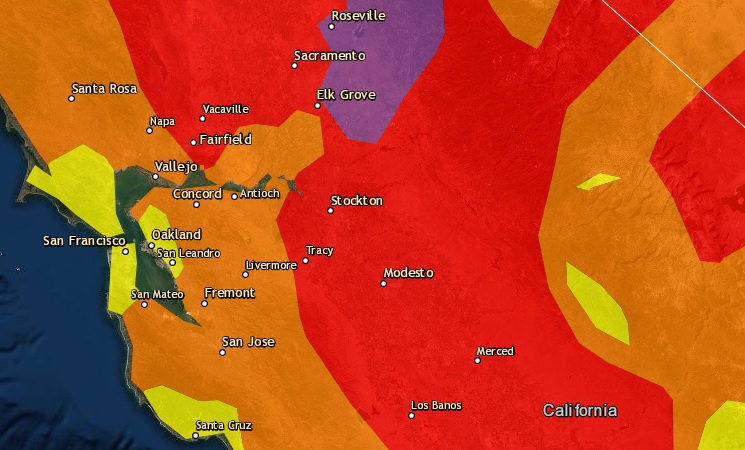
Today the air is miserably smoky and it probably would have been better to stay off of the bike, but I decided to ride anyway, and just go very easy. That I did: my average heart rate was all of 91 BPM, which is low enough that I could do all my breathing through my nostrils and hopefully avoid getting those evil PM 2.5 particles embedded deep in my lungs.

Smoke ’em if you got ’em, and we got ’em everywhere

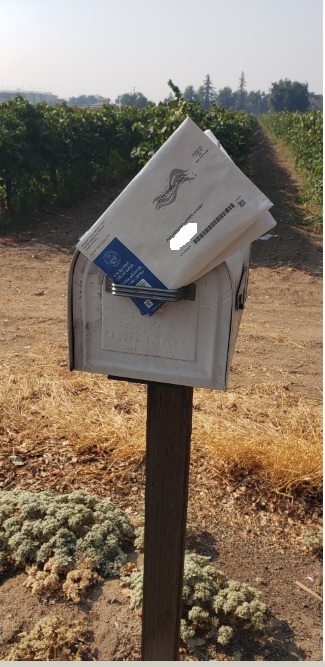
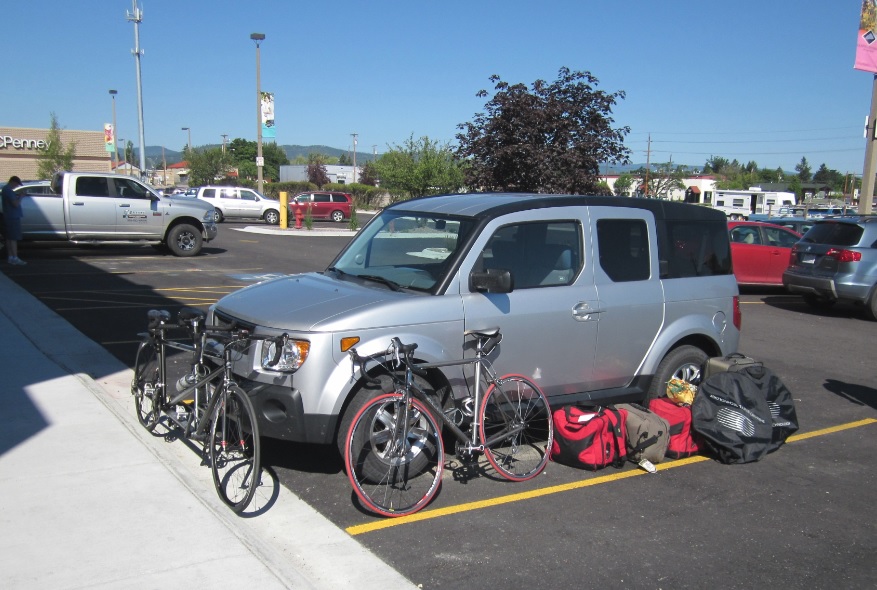
As I was pedaling on the east end of Armstrong Road, I noticed some envelopes on the side of the road that looked the official mailed ballots that Stoker and I recently received. I circled back and took a look. Sure enough, there were two ballots sitting on the ground at least 100 yards from any house or mailbox.

I took note of the address on the envelopes, then rode my bike looking for the house. It was only about 200 yards from where I found the ballots. No one seemed to be home, so I put the ballots in the mailbox with the same address as the ballots after taking this photo. The names have been redacted for national security reasons.

Mistakes happen, but finding two ballots alongside the road does not exactly inspire confidence in the integrity of our mail only elections. I mean, a less scrupulous person could have marked the ballots, faked a signature hoping no one would check, and mailed them. No one would ever catch me if I did that.

I was somewhat tempted to cast two more votes with my preferences (which I’m sure my readers can guess, but this isn’t a political blog and I ain’t sayin’). But I didn’t, of course. That would be wrong. One person, one vote. If you can retrieve your ballot from the side of the road, that is.

Toe the Line…

Or perhaps ‘line the toe’ with some kind of bandage or padding. Though it is a bit late for that now.

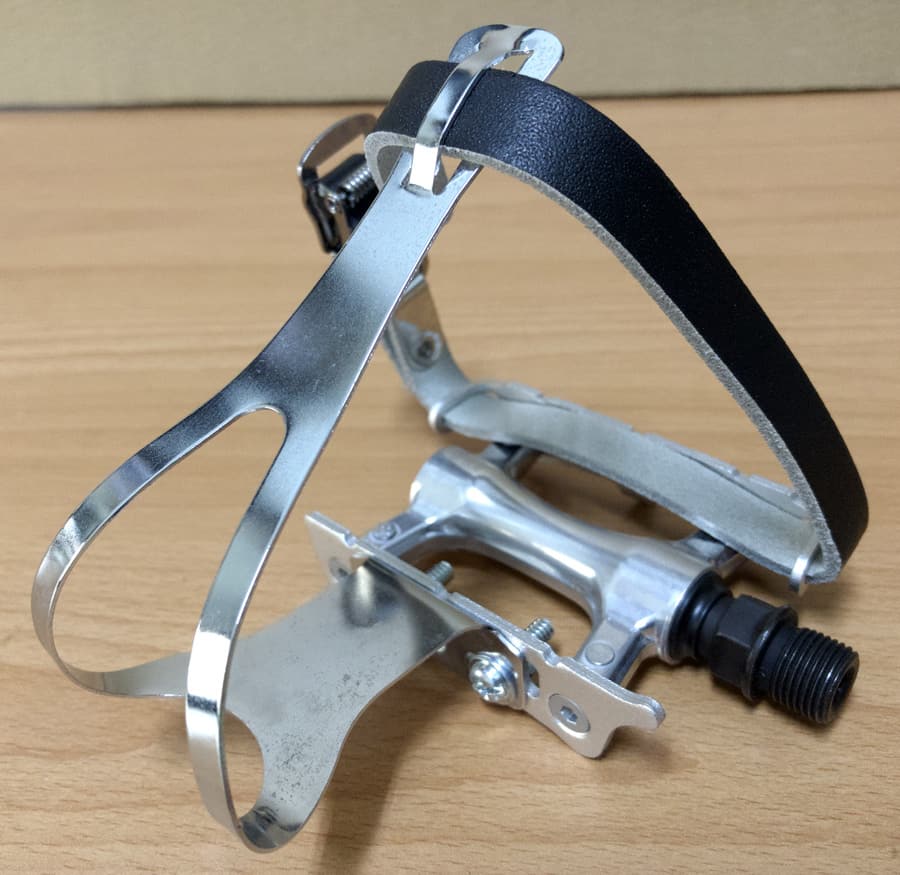
If you have been cycling for more than 35 years, you will remember that pedals were equipped with metal toe clips and leather straps to keep your cycling shoes firmly attached. These devices did the job, but they resembled some kind of torture implement used by Torquemada to extract confessions from non believers.

Pro riders used to tear their shoes off after tough stages, then pour water on their feet to try to get some relief. Later the riders suffering from ‘hot foot’ would work their way back to the race doctor’s car, and beg for some ‘Freeze It’ spray to try to ease the discomfort.

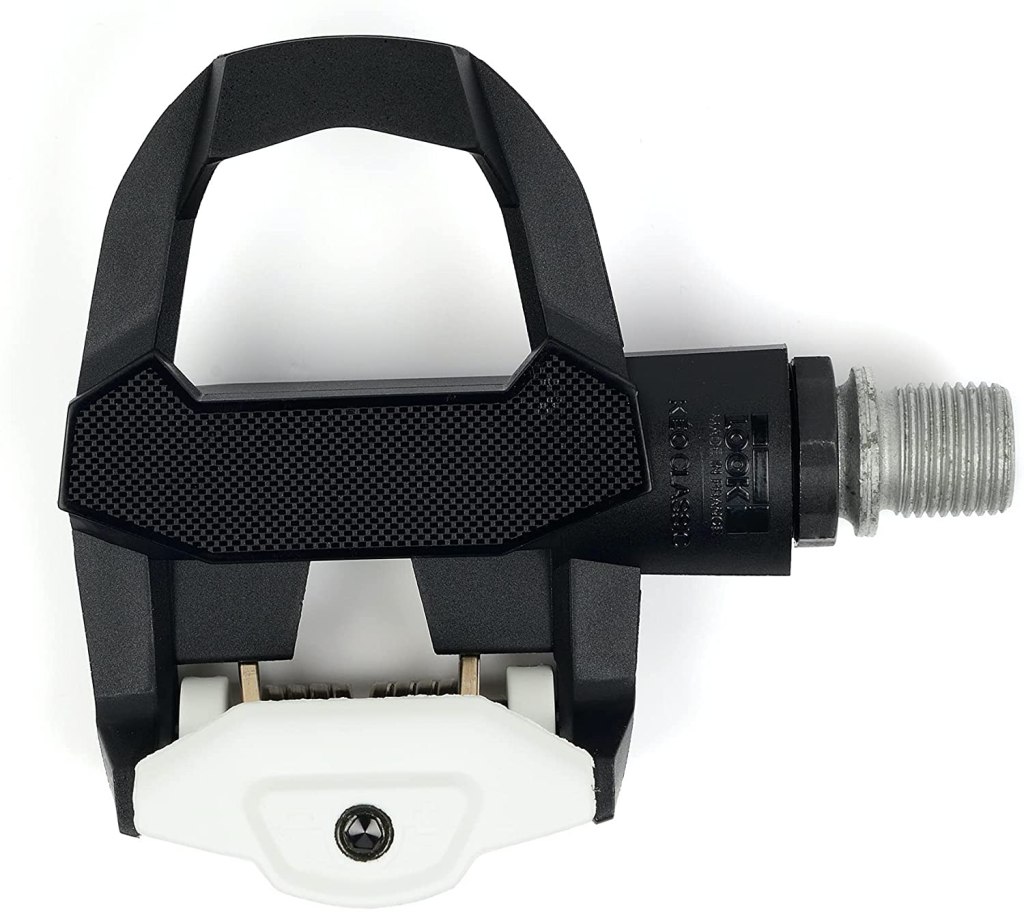
Around 1984 LOOK came up with the first widely accepted clipless pedal. The system acted a bit like a ski binding, which LOOK also manufactured. There was a cleat that you attached to the bottom of the cycling shoe, and it snapped into a retaining mechanism on the pedal itself. To release the shoe you simply turned your ankle away from the bike and the cleat would pop free.

There was a bit of initial skepticism among riders, who were concerned that the pedal might accidentally release under heavy pedaling pressure, which could result is an horrific crash with damage to vital body parts. But ‘encouraged’ by sponsors (“ride this or else”) the pedal was widely adopted by pros and amateurs alike. The fears of unintended release were unfounded and the system proved to be extremely reliable. It was actually even safer than the old style equipment. If you crashed, and the pros crash a fair amount, the cleat would almost always release and your knees and ankles wouldn’t twist and perhaps tear muscles or tendons. With the old pedal system you were locked in and twisted joints were a real risk when you hit the ground.

And wonder of wonders, the new system was a quantum leap in cycling comfort. No more steel toe box jammed up against the front of your shoes. No more leather straps biting into the top of your foot. By 1990 it was hard to find a serious cyclist who had not converted to the new clipless world.

I usually do not have issues with my feet on rides under 3 hours long. However, when the ride length goes over 4 hours and especially if there is a lot of climbing my tootsies start complaining. I remember one time climbing Pacific Grade at the end of the Bear Valley to Markleville ride (something like 72 miles, 8,000 feet and over 6 hours) I stopped just after the last switchback. It wasn’t the 20% pitch that did me in, it was the enticing snowbank promising some cool relief for my screaming feet. I iced them down and pedaled on numbed and happy.

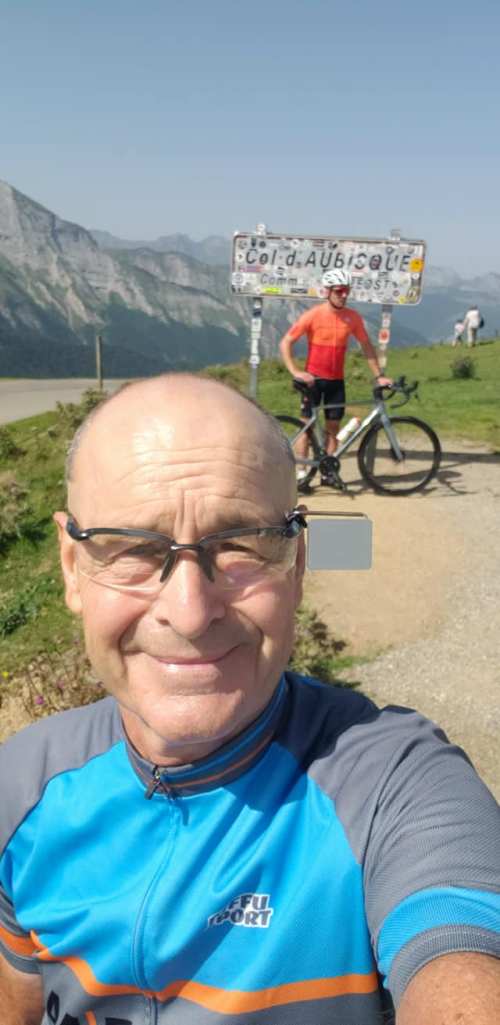
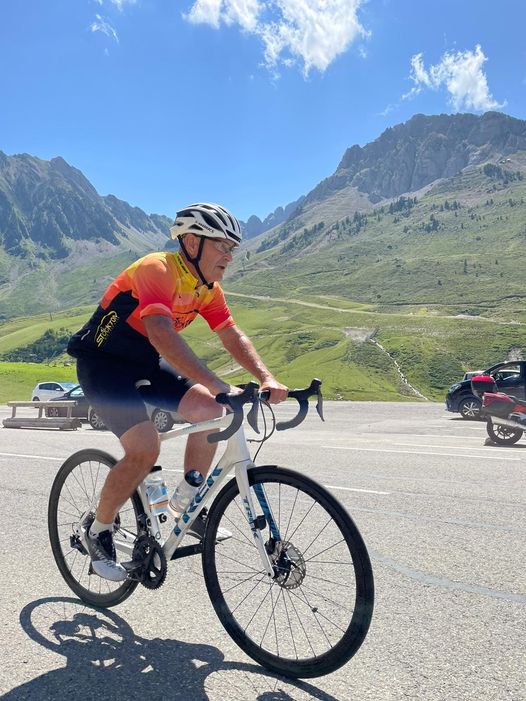
So foot issues are nothing new for me, but on my recent trip to the Pyrenees I encountered something new. On our 7th and final ride we started with the Col de Bagargui, and on the 3.1 mile section that averages 12.8% I was feeling some pressure on my left toes. Of course on a road that steep everything hurts so I didn’t pay much attention.
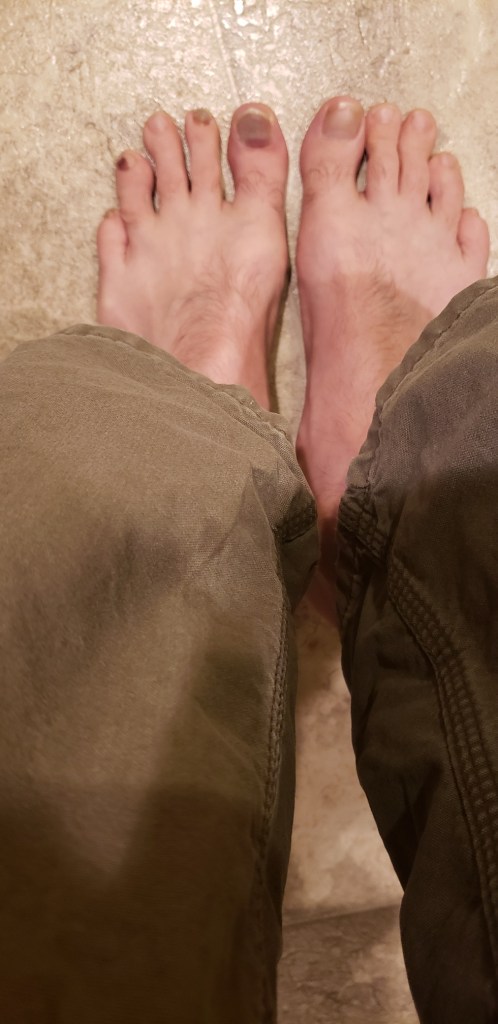
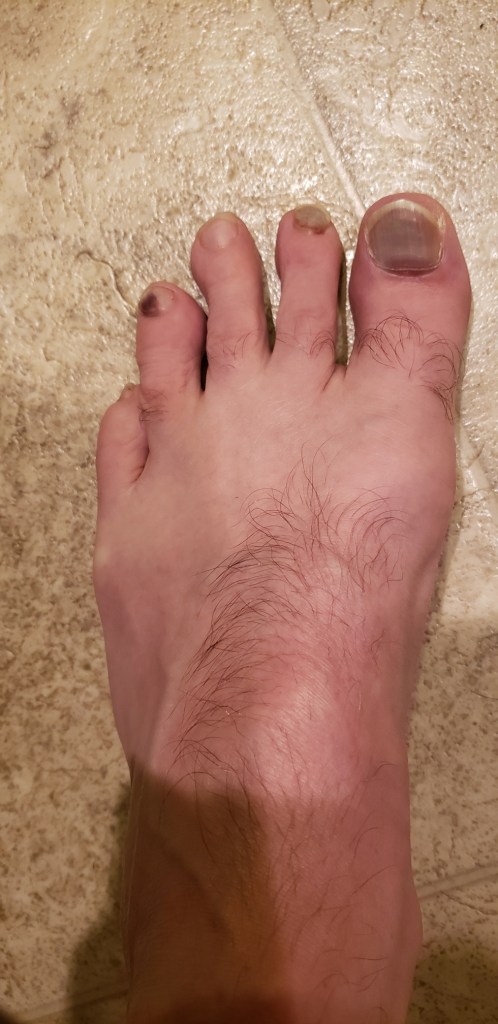
The pressure continued for the rest of the ride, and when we finally got to St. Jean de Luz I was glad to take off my cycling shoes. And look what I found…

I’ve never seen toe bruising this extensive as a result of a bike ride, or anything else for that matter. I don’t know if I’m going to lose any of those nails, and I am being careful when I put on and remove socks. And I’m really trying hard not to stub my toe against anything, which is always a good plan but seems especially important now.

Since I’m done with the Pyrenees I have no plans to do any 5+ hour rides until next year. And when I do I might consider thicker socks or some kind of padding to ease the pedaling pressure. Or hope to find a convenient snowbank.

Perfect Pyrenees

It was wonderful to get on an airplane and head to France for a week of cycling. Of course wearing a mask for 2 hours at SFO, 2 hours boarding and waiting at the gate and taxiing, 10 hours in the air, 6 hours at Charles De Gaul in Paris, and 2 hours flying to Toulouse and waiting for luggage was a little less than wonderful. That is a total of 22 hours masked up. The only time the masks came off was during meals or cocktails. That is a lot of CO2 rebreathing.

I was in France for 44|5’s Pyrenees Tour. I did this ride back in 2017, and thought it was such a wonderful cycling trip that I wanted to come back to do it again. On the first trip I surprised myself by actually riding pretty well. But before this reprise trip I had severe doubts about my cycling shape.

Ever since the first Covid lockdown I have felt like my cycling strength has severely deteriorated. I haven’t been riding as much or as hard or doing as much climbing. Stoker and I stopped riding hills, since the main reason we do that is to get prepared to ride together in Malaucene, which didn’t happen for two years in a row.

Maybe it is age (I’m on Medicare now!), maybe it is lack of motivation, but I wasn’t at all sure I was ready for the Tourmalet (9.5 miles, climbing 3900 feet, 7.8% average grade) or Hautacam (8 miles, 3400 feet, 8.0%). or some of the other big climbs in store. After a warm up day on Saturday, we had six days of major climbing planned. The total for the week was 330 miles and a whopping 42,000 feet of climbing.

I did most of those miles, and I actually rode a lot better than I expected. Consider that back in 2017 I climbed the aforementioned Tourmalet in 1:52:37. This year I did it in 1:53:03! Now that is consistency. Mediocre consistency of course. In 2017 Hautacam took me 1:28:12 to reach the summit, and this year I managed 1:33:10.

The only climbs I had to sag were the ‘Col d’ Hotel’ up to Larrau and the road from the Col du Soudet up to the Col de Pierre de San Martin. I got a flat at the base of the Col d’ Hotel and couldn’t figure out how to work the through axle, so I had to call for help and by the time the van arrived I decided that 72 miles and 8200 feet was enough for the day, so I skipped the final 3 km climb of 750 feet. The next day when I got onto the open upper slopes of the Col du Soudet, the wind was howling and I didn’t want to do the final stretch up to the San Martin and possibly get blown off the road either going up or down. So I missed about 1,500 feet of the climbing and ended up with 310 miles and 39,800 feet for the trip. This is by far the biggest week of cycling for me since August 2019.

The final day’s ride from Larrau to St. Jean de Luz was a big one, starting with the very difficult Col de Bagargui. The Col started almost as soon as we left the hotel. The first 3.3 miles average a reasonable 7.0%, but then things get serious: the next 3.1 miles average a whopping 12.8%! That is an extraordinarily difficult climb when I’m fresh, which on the 7th straight day of riding I certainly was not. But I made it up without walking. Thanks to Strava I know that back in 2017 I did the Col in 1:19:55, and this year it only took 1:20:38, less than one minute slower. More mediocre consistency.

So my first European cycling trip since 2019 was a success. I have been saying for years that as you get older it is better to take one challenging cycling tour too many than one too few. Since the Pyrenees went well I will be back for more in 2022. The plan is to spend a month in Malaucene with at least a little tandem riding, followed by a week in the Cevennes and thence to Belgium for pave and cobbled climbs and beer. I don’t know if Covid will allow this but if my legs behave like they did last week, I’ll be ready for it. Koppenberg, here I come!

You Need a Pass to Pass

I have just returned from a wonderful week of riding the in the French Pyrenees. It was my first trip to Europe since August 2019 in the Dolomites. Covid put all non-essential international travel on hold for almost two years. I might suggest that cycling in Europe constitutes essential travel, but I doubt the CDC would agree.

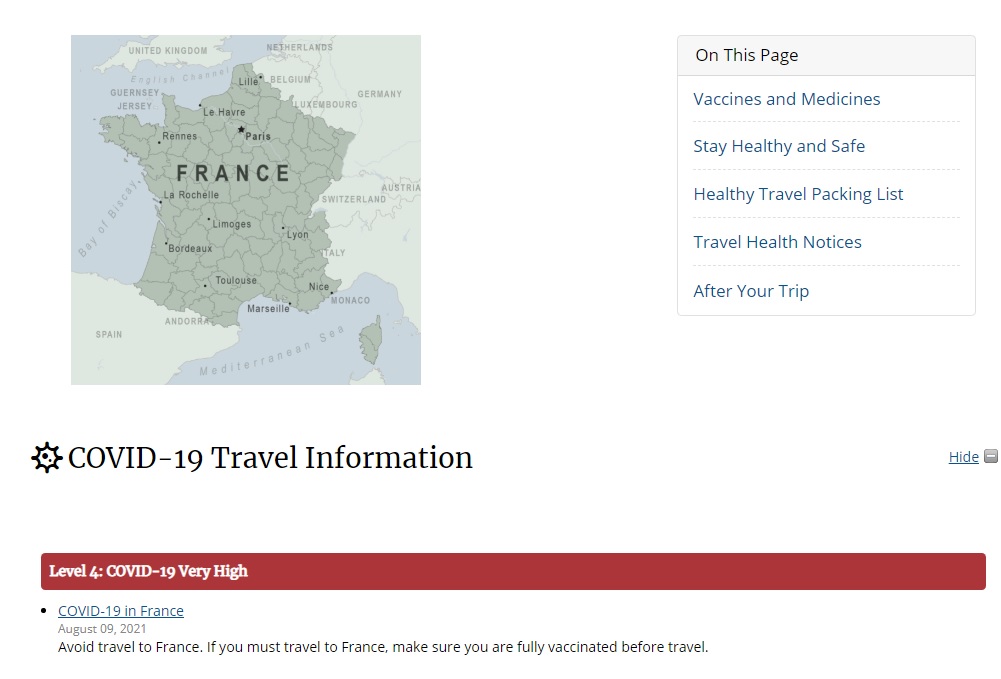
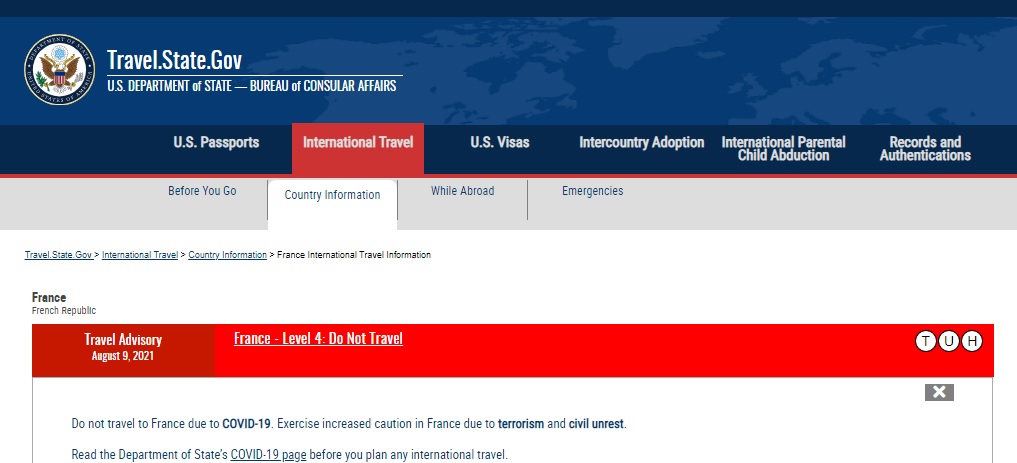
Speaking of the CDC, look what came they came out with about 5 days before I flew to Toulouse. And while I was in France the State Department chimed in too.

There were some added complications. My CDC vaccination card got me a boarding pass at the airport and was sufficient to satisfy my hotel in Toulouse. But during our trip France put new regulations into effect requiring le pass sanitaire before you could check into a hotel or eat at a restaurant or cafe. Le pass required a QR code, and it wasn’t clear how I was going to use my CDC Card, which had no such code, to get the French version.

My favorite touring company, 44|5, came to the rescue! Before the trip John and Gerry had us all send copies of our CDC Cards and passports to them. John found a French pharmacy that would enter the information into the French system. So we had our French passes on paper when we started the tour, a day before the new French requirements went into effect. Gerry advised us to download an app that would allow us to scan our paper versions into our cell phones and create a digital wallet which would allow us to show our pass when requested.

And requested it was, at least at all the places we stayed or ate at. Walk into a cafe wearing a mask, and before you get shown to a table you pull up the pass QR on your phone and the host takes their phone and scans it. There is a reassuring ‘beep’ that says you are good to go, so you get seated and immediately the masks come off and stay off for the duration of the meal. Which is not rushed in France.

Same thing when checking into a hotel, except there the masks stay on whenever you are inside the building, unless you are seated at a bar or restaurant or breakfast table. Why masks are necessary in deserted hotel hallways but not necessary in crowded restaurants is unclear, but this conundrum is certainly not unique to France.

There was some question about how the French would react to the pass sanitaire requirement. There were large protests about the issue, and long lines outside pharmacies for shots when it became apparent that if you wanted to sip an aperitivo you were going to need a QR to do so. At one hotel a potential restaurant customer (not an American) took exception to the requirement and a debate (in French) with the hotel owner ensued. The innkeeper was adamant: no pass, no meal. Thanks to Gerry listing in and translating, I know that the owner could be fined 1300 euros for a violation.

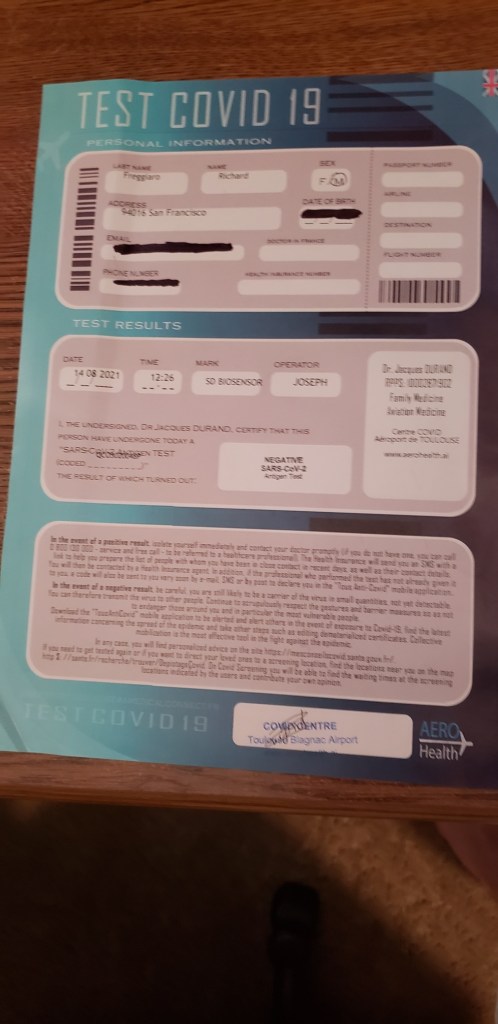
A CDC Vaccine Card got me into France, but it wouldn’t get me home. Reentering the U.S. required a negative Covid test within 72 hours of boarding the flight. 44|5 came through again. Gerry made appointments for us at the Toulouse airport the day before our flights home. He escorted us to the testing station and handled the check in. 15 minutes later, four Americans had their negative tests in hand. And fewer euros in those same hands; we had to pay 42.50 euro each (about $51) for the test.

So those are the current rules on the ground for travelers to France and French citizens. We followed them and got places to sleep and eat (very well by the way) and were able to fly home. Stories about the riding and eating will follow, stay tuned…

More Precious Than Gold

After a wonderful week in South Dakota, the sad fact is that the journey home was much less pleasant. I’ll spare the details but suffice to say that for 11 hours we had masks on continuously save for a blessed 45 minutes sitting at a table at Smashburger in the Denver airport eating burgers and drinking vodka.

Our flight to SFO was delayed, then after we boarded we sat on the ground for another 45 minutes because we had lost our place in the take off queue. This plane crammed a remarkable number of people into a confined space, and when Stoker looked at the way my knees folded against the seat in front of me since there was no place else for them, she remarked that I must be uncomfortable. Really darling, what gave you that idea?

We skipped the overpriced and under iced airline vodka, and eventually arrived at SFO. The bus home was considered ‘private transport’ so we didn’t have to wear the masks. Finally around 12:30 AM our bus arrived at the location where our cars were parked. We were both looking forward to getting home to a glass of Cote du Rhone and a reunion with Luke the Dog.

I put the bags in my Honda Element and fired it up. There was a huge roar, and I thought the plane had followed us to Stockton and was attempting to land. But I shut off the engine and the noise went away. I tried to start the engine again, and the same thing happened. Then the light bulb went on and I realized someone had stolen the catalytic converter.

Shock was soon replaced by fury. The tour company paid for permission to use this lot. There was 24 hour live person security. There were surveillance cameras. Didn’t seem to matter. Everyone had waivers in place of course, but that didn’t stop me from making a few heated remarks about the state of affairs.

Our tour guide was incredibly helpful. She got her husband to come and give Stoker a lift to Casa Brumby in case Luke the Dog needed to go outside to go. I waited for the Deputy to arrive to take my non-emergency report. The Deputy was sympathetic but told me not to get my hopes up regarding recovery and arrest. He said he had taken hundreds of these reports and made a grand total of 1 arrest. Probably released without any jail time either, it being a non-violent offence.

Finally I got home and opened that bottle of Cote du Rhone. Luke was glad to see me and jumped into my lap, but he must have sensed tension because he soon left for his other chair which he allows Stoker to share. I did limit us to a single bottle although I was sorely tempted.

None of the other cars was touched. I have since learned that Honda catalytic converters from models circa 2002-2012 are favored by the catalytic bandits. The Element has the added benefit of a high ground clearance which makes it much easier to crawl under with a cordless Sawsall and cut the muffler.

Thieves target catalytic converters because they contain precious metals, like platinum, palladium or rhodium, that are valuable to metal dealers. Honda converters on older models are favorites because they contain more of these metals than run of the mill converters. And the prices of these metals have soared recently, so thefts are epidemic, and no location is safe. My brother has a motor home he parks under cover at a locked storage facility surrounded by a 10 foot chain link fence. Some gang scaled the wall and took around 15 converters in one raid. Including his.

For the past two days I’ve been dealing with towing companies and repair shops and insurance claims agents and adjusters. I must say that I have been treated very well by these folks. The adjuster and the shop agreed on a price, a whopping $3500! But I only have to pay $250 of that. I have a nice rental car, much nicer that the my poor old Element, for free. Everything went smoothly and quickly and my financial loss is minimal.

But I’m really disturbed by how crimes like this are so prevalent and nothing seems to happen to the perpetrators. My out of pocket costs are minimal, but the cost to society is much larger since insurance companies have to make a profit and increased claims mean higher rates. Same for retail prices: thanks to cell phone cameras and the internet we can see brazen incidents of shoplifting daily. People walk into stores and walk out with bags full of stuff, and nothing happens. The State says they won’t prosecute cases and the store employees are told not to confront the thieves lest the situation escalate to violence and someone get hurt.

Over the years I’ve had two nice bikes stolen, and we suffered home break ins at Casa Brumby and at a house we were renting in Phoenix. Add the catalytic converter to the list. The Bible advises us to forgive those who trespass against us. But it also suggests appropriate punishments along the lines of ‘an eye for an eye’. I guess I’m kind of an Old Testament type.

Dakota Picnic

Once upon a time, there was a big celebration in Lodi put on by a group of northern plains emigres called the Dakota Picnic. It seems a lot of people from that part of the country moved to California to escape the Dust Bowl and found paradise with no cold winter weather. So they put on a big celebration to eat bratwurst and drink beer and dance the polka.

Today of course, the migration is moving the other way. Stoker and I have friends who have moved to Idaho and Iowa and Kentucky and Ohio and even Florida. So far Stoker and I are staying put. But we did just take a one week trip to South Dakota, touring the area around Rapid City on a bus instead of a bike.

We were on tour with Setness Tours, a local company that runs day trips and week long tours and overseas excursions to many destinations. We have toured with them before and can say that they put together some great itineraries. Check them out at https://www.setness.com/ .

South Dakota definitely has a lot to see. We went to Lead (rhymes with deed) and Deadwood. We toured the huge Homestake mine and enjoyed a buffet lunch in a casino, something we never do.

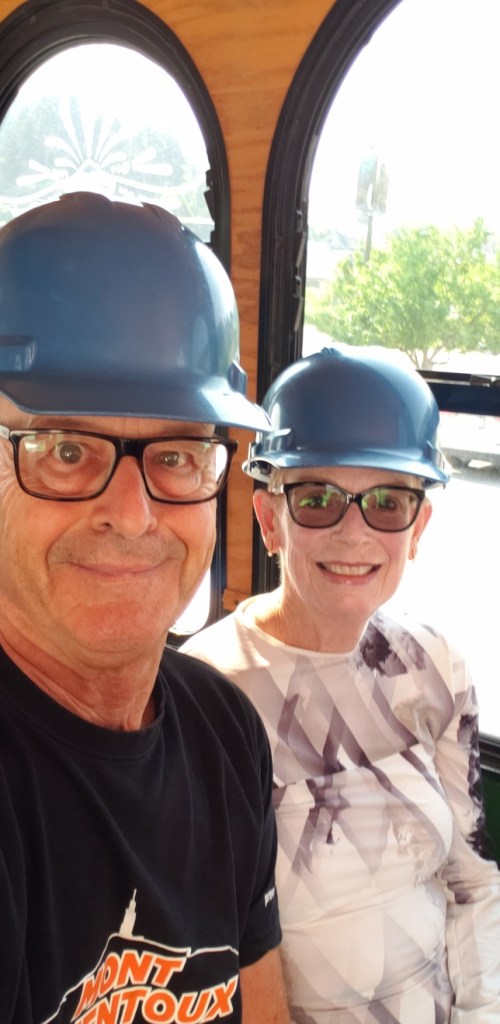
On the bike or on a mine tour, wear a helmet!

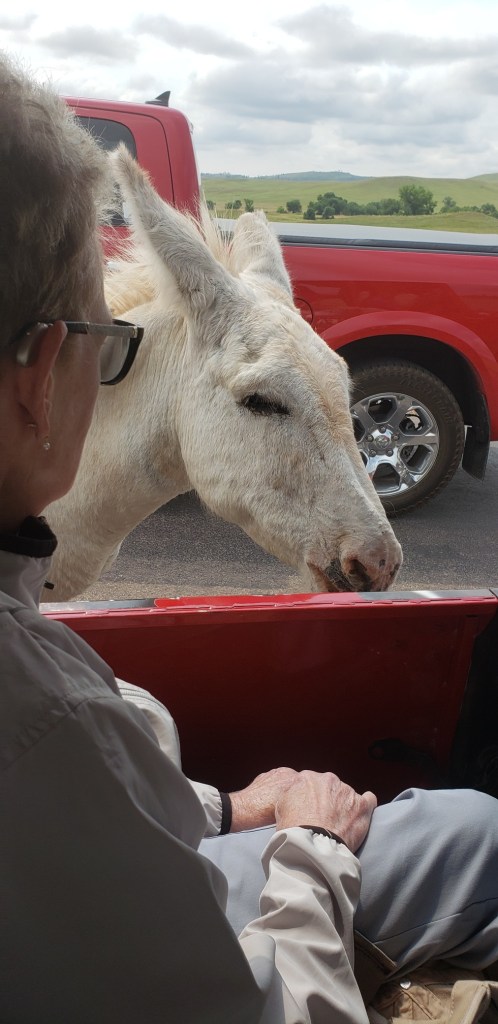
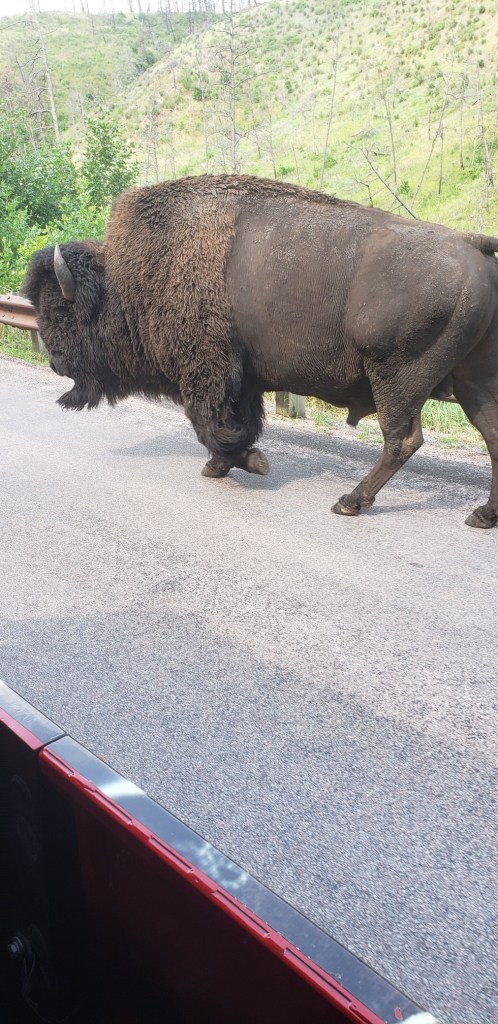
We went on an open air bison safari and saw lots of the massive beasts, along with deer and elk and big horn sheep and wild Modestines that loved to beg for carrots.

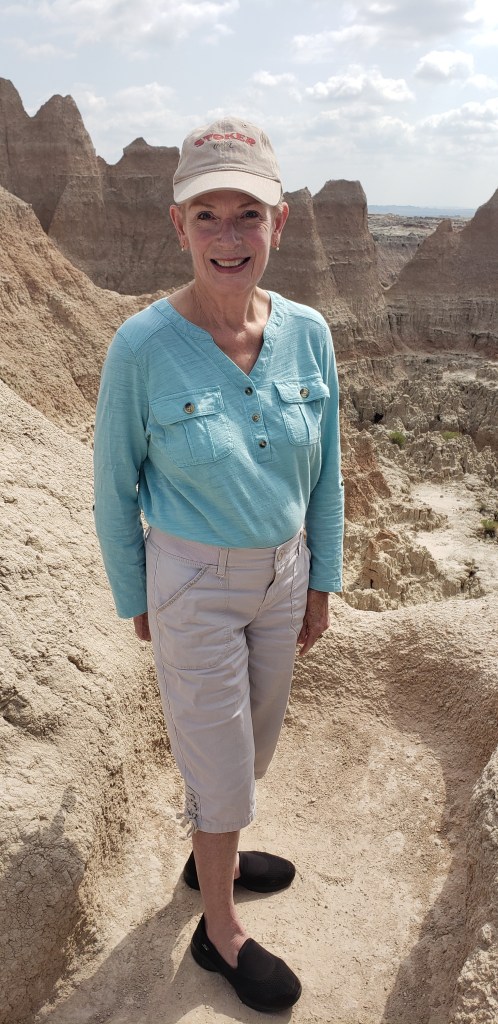
We went to the Black Hills National Park and Badlands National Park and Custer State Park, which so far retains its name, as South Dakota is much less ‘woke’ than many other parts of the country. All the countryside was very impressive, but Badlands is especially so. From Rapid City you drive through what seems like infinite miles of rolling grassland prairie, then suddenly you come up to this:

The road through the Badlands National Park would be spectacular for cycling, but there are way too many cars and campers and trailers and tour buses. So I was kind of shocked to see the Trek Travel had a tour with at least 20 riders. The scenery was truly magnificent but it cannot have been a pleasant cycling experience.

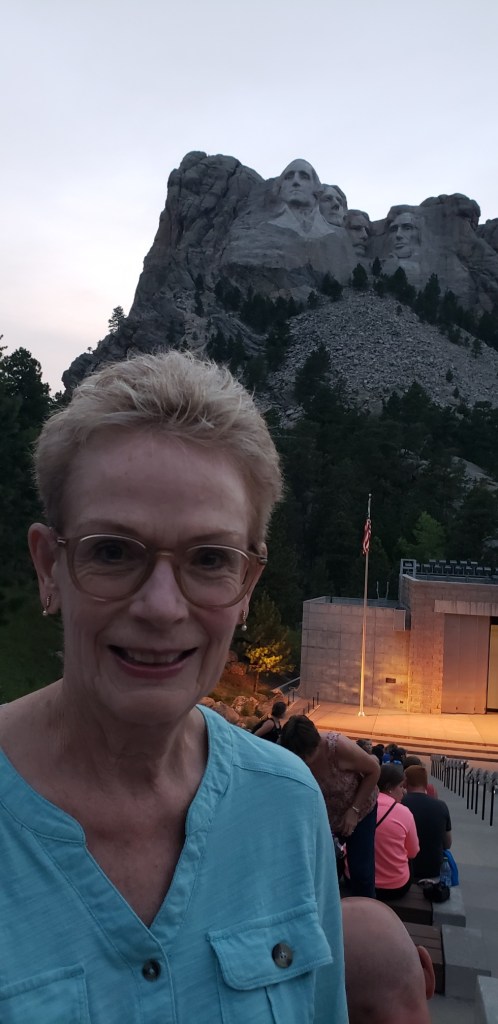
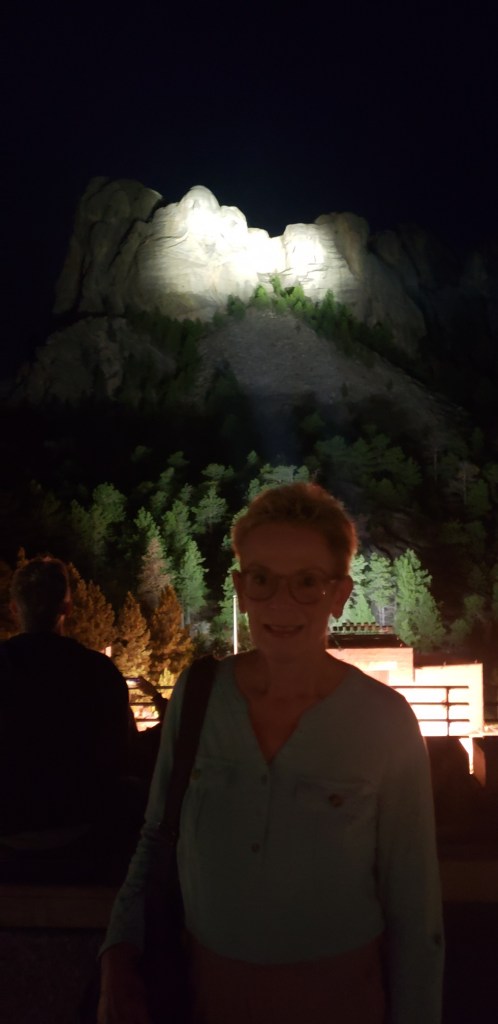
And no trip to the area is complete without a trip to Mount Rushmore. We did it twice, once during the daylight hours and once for The Illumination. The Illumination is a ceremony that begins at 9 pm with a dramatic speech from a ranger who spoke of freedom and liberty and how in America we are free to do what we want and go where we want and be what we can be. Although I wanted to put away my political cynicism in such a dramatic and patriotic setting, I had a nagging thought about whether this has been true for the last 18 months.

At 9 pm there is still enough light to see the monument towering high above the amphitheater. But as the talk and the movie proceed, darkness comes on and it disappears. Suddenly, as the movie reaches its climax of a patriotic tribute to our country, the spotlights go on and the presidential faces high above are brilliantly lit up. Time for some goosebumps.

More goosebumps follow. We sang ‘The Star Spangled Banner’, and as far as I could tell everyone sang with full voice, on key or not. Finally, the ranger who had given the dramatic speech invited all veterans and active duty personnel to join her on stage to take down and fold the American Flag.

There must have been over 100 people who came up on stage, to sustained and enthusiastic applause. Then as the flag was lowered and folded there was dead silence from the crowd of more than 2000 people watching. When the ceremony was complete everyone left both subdued and elated and maybe a bit teary.

We lightened things up the next morning at an animal park. Along with the many animals roaming in a natural setting there were four baby bears cavorting and swimming and climbing trees and wrestling with each other. If that didn’t make you smile, check to see if you have a pulse. Then off to the airport for a couple of flights and around 7 hours of continuous mask wearing, vaccinations be damned. We were able to remove them for burgers and much needed vodka in the Denver airport, but after we left Smashburger it was masks on all the time, as the flight attendant seemed to take great joy in reminding us. Even between sips of the water they allowed us, we were supposed to pull them back up. I struck a small blow for freedom by holding my bottle to my lips unmasked for about 1 minute, risking rebuke. What a rebel I can be!

A surprise awaited us when we finally arrived at our cars back in Stockton sometime around 1 am Saturday morning. But that is another blog…

5-Way Split

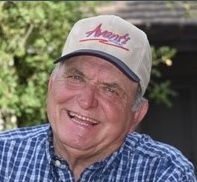
Avanti Nut Company is very much a family business, and 10 days ago its patriarch passed away suddenly and unexpectedly. Andy Solari leaves behind a legacy of 6 children and 12 grandchildren, as well as successful farming and walnut processing operations. The funeral in Linden on Wednesday was SRO and then some. There must have been nearly 1,000 people there.

In 2007 I started working at Avanti during the walnut harvest to give me something to do in retirement other than ride my bike and bother Stoker. For 6 weeks during September and October I spend more waking hours in the scale house than I do at home. Before this I really didn’t know Andy other than by reputation as a big farm operator. But over the next 14 years I became well acquainted with him and his 6 adult children. 4 of them are involved in farming with J & A Solari or with Avanti, or both.

My job at Avanti is mostly clerical, with spreadsheets and databases. I’m also a weighmaster, a high sounding term that just means I push a few buttons that control a scale to weigh trucks full and empty to determine the net pay weight. I don’t have the skills that the Solari children all seem to have been born with to drive forklift or a yard goat with a set of double trailers onto and off of scales and unloading elevators. But despite my shortcomings in the forklift department Andy always treated me as an important and valued part of the Avanti team.

Andy was a constant motion machine, as are his offspring. They are go-go-go types, who don’t always want to slow down to carefully keep track of the paperwork. That is my job, and if I do say so myself I am pretty good at it. Order, system, and organization are what I bring to the deliveries from multiple growers and multiple ranches and multiple dryers, all of whom get paid by the weight on the scale. Excel does the work but I have to tell it what to do.

Occasionally Andy would come into the scalehouse with a question about how many deliveries came from a certain ranch and how that compared to last year. Or he might want to know what the quality grades were for a certain field. With a few clicks I was able to provide the answer, which impressed him. I can’t drive a forklift but I know my way around a pivot table!

My favorite Andy story involves split loads. Most walnut deliveries come in sets of double trailers that weigh around 24 tons net. But there are some small lots, or small lots left over from bigger fields that are put in small bins of up to 1200 lbs. and delivered on a trailer. Andy would bring them to the Avanti scale and we would start the split load procedure.

It takes me just as much time to do the receiving process for a single 1,000 lb. bin as it does for a 48,000 lb. load. A 2-way split means there are two separate lots to deal with. A 3- way split is 50% more work than the 2- way. So a 5-way split is a time consuming process. But during walnut receiving season time can be in short supply.

Andy is calm but in a hurry, not surprisingly considering the scale of his harvesting and drying operations during the walnut harvest. The scale is tied up while each small lot is put on the scale, weighed, then taken off. I have to get the bin labels printed and stuck on the bins, which means I have to put the delivery information into the computer database to print the labels. I have to keep the receiving papers from the dryer together with the correct weight certificate and draw and label the grade samples. All this takes time. Nina is usually driving the yard goat with a set of doubles poised to weigh in or weigh out and looking impatient since the scale is tied up and she is forced to sit idle, which is not to her taste at all. I try to work as quickly as I can. By the time the 5 way split is done with and both Nina and Andy are on their way, I am one frazzled weighmaster.

Now that Andy is gone, I know there will be more 5-way splits to deal with, but it won’t be the same. I’ll miss his smile and his handshakes and his laughter. I don’t think I ever saw him in a bad mood, even when his weighmaster got flustered trying to get things done at ‘Solari Speed’. Avanti means ‘forward’ or ‘ahead’. An appropriate word for Andy’s memory.

Primo’s Problem

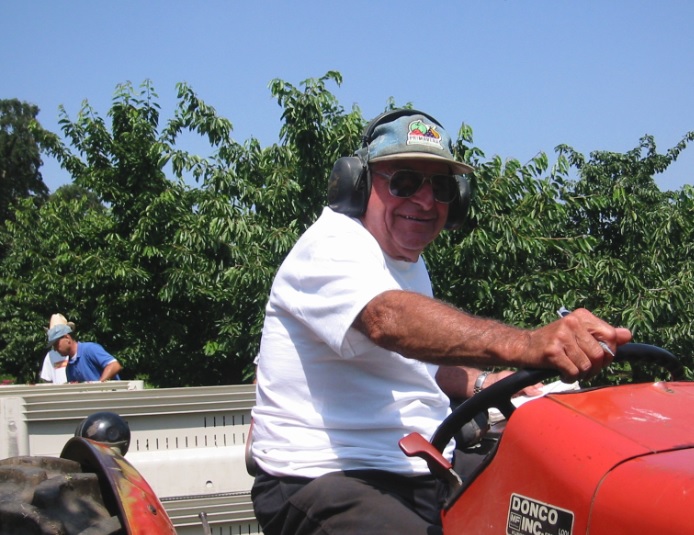
Ms. Hermana’s visit got me reminiscing about cherry season and all the years we hired pickers to harvest the fruit. For decades my father ran his own cherry crew without using a contractor. My mother did all the bookkeeping, which was vital since both Dad and I were too tired from the long work day to post box totals to each picker’s pay sheet. Mom also did those dreaded labor filings to the EDD and SSA.

But eventually all the labor paperwork and I9’s and safety training requirements and pesticide notifications got to be too much, especially since we didn’t have a Human Resources Department. We only needed 30 to 40 people for two weeks each year. So we got lucky and found an honest contractor who took care of all that stuff, for a fee of course. Money well spent.

There are cherry picker stories galore, especially from the days when we ran our own crew. One year RL, a descendant of Dust Bowl migrants, showed up with a brand new motor home towing a Dodge Charger convertible. This was back in the 1980’s, and RL had actually won $1,000,000 in the State Lottery. The prize was paid out in installments of $50,000 per annum for 20 years. In those days this was life changing money . It was more than Stoker’s and my incomes combined in the 1980’s. Considerably more.

The money did change RL’s life; it bought him a new car and motor home. And left him broke until the next installment. So he had to go to work picking cherries to pay for gas and beer and cigarettes. No financial planning for him!

My favorite cherry picker story is completely different. One year we hired a new employee named Primo Delgado. He was the first Delgado brother to come to work for us, and it must have been to his liking because the next year he was joined by his brothers Adelmo and Juan and Jose. Those guys could really pick cherries, fast and clean, no stemming or bruising.

But on Primo’s second day of employment there was an incident. To understand what happened you should know that pickers are assigned a group of trees (usually 6), called a ‘set’. They pick all the trees in the set and then move ahead to the next open set. There is a row called a ‘drive’ which is where they place all the full boxes. My dad drove the tractor up the drive pulling a trailer with bins. He had punch cards and a notebook and a hole punch with him. He would stop at each picker’s stack of boxes. I would count the boxes and tell my dad (sitting on the tractor, no need to get on and off 100 times a day) how many so he could punch holes in the picker’s card. Pickers get paid by the box, and before we hired a contractor and Ms. Hermana did the checking, that was our responsibility.

Next I would dump the fruit from the 35 lb. box into the bin, very carefully. Then I would find the picker and tell him how many boxes we had picked up to confirm with him/her the count was correct, and then follow the trailer to the next stack. I used to lift anywhere between 300 and 800 of these crates a day. I think one day we picked 1000.

With that backround, here is what happened. We pulled up to Primo’s stack. I counted five boxes, told my dad 5, dumped them into the big white bin, then found Primo and told him “Cinco cajas”. I like to pretend I know some Spanish.

Primo frowned and said “No, seis. Seis cajas”. Now I have a problem. There are three possibilities:

  1. I made a mistake. Rare but possible.
  2. Primo made an honest mistake. Possible. But people who are being paid by the box are usually quite aware of how many boxes they have picked.
  3. Primo was trying to cheat me.

Possibility 3 was by far the most likely. But I couldn’t be sure, and there was no way to tell since there were empty boxes everywhere. This situation was quite rare on our ranch but when it did happen our policy was to take the picker’s word. Once. If it happened again with the same person we would pay him/her off at the end of the day and tell them not to come back. I don’t think that ever happened.

So I told my dad to mark 6 boxes. I said I thought I dumped 5 but I made a mistake. I looked at Primo and told him “Seis cajas. Lo siento” (I’m sorry).

As I turned to walk to the next stack Primo told me, in English, “Maybe five”. What followed was a kind of pax de deux, because I didn’t want him to think I was pressuring him to change his count. And he didn’t want me to think he was cheating us.

Remember this is Primo’s second day. I thought about this for a long time and I think I know what happened. Primo had probably been cheated by contractors and coyotes and unscrupulous growers many times. He had to try to get an extra box, because in his world you have to look for any edge you can get. And he succeeded. I would have given it to him, no questions asked. As I said, once.

But Primo had second thoughts. He was picking some nice trees and getting a lot of boxes. He was being well paid for those boxes, more than at virtually any other ranch around. He got away with the scheme, but his conscience wouldn’t let him keep it. He saw my dad and I working plenty hard, and saw we treated people fairly. He decided to reciprocate.

Primo’s brothers were a fixture of our cherry crew for years. They even went to work for our contractor when we quit running our own crew, which told me that we had hired an honest contractor. But Primo disappeared after a few seasons. His brothers told me he was working on “caw blay”. That is the Spanish pronunciation of ‘cable’. Primo was installing cable TV and internet lines in the Bay Area. Another move up, just like Ms. Hermana.

But early in May a few years later, who shows up at my front door but Primo. He wants to know if he can have a job picking with his brothers. I said sure, but what happened to the ‘caw blay?” He smiles and said “tengo vacacion”. He had some vacation time and wanted to come pick fruit and camp with his hermanos. So I guess picking cherries along Brumby Road did not constitute worker exploitation. Take that Dr. Marx!

American Beauty

Last Wednesday around 5 PM Stoker and I were getting ready for our evening ritual of self medicating with a mood elevating, muscle relaxing beverage in order to watch the news of the day without getting apoplectic. The doorbell rang, and we assumed it was simply another of the endless stream of Amazon deliveries that find their way to Brumby Road. I halted my pharmaceutical preparations and went to bring in Diane’s latest purchase.

I was in for a surprise. There was a woman at the door, masked up. I opened the door and stared at her, thinking she looked familiar. When I heard her gentle voice, with a light Spanish accent, say “Hello Richard, do you remember me?” I knew instantly who she was.

Her name is not important and I’m going to respect her privacy. Let’s call her Ms. Mi Hermana. If I had a sister I would want her to be someone like the woman standing on my front porch. I was very happy to see her. It had been a long time, at least a dozen years.

Years ago, when my father and I were still farming, we finally decided that running our own cherry picking crew was too onerous a task, so we hired a contractor. This relationship worked out quite well for many years until we retired from farming. Ms. Hermana worked for the contractor as the ‘checker’. She kept track of how many boxes of cherries each employee filled and got paid for. My job was the ‘swamper’, which means I loaded the boxes onto the trailer and picked up empties and moved ladders and loaded bins onto our truck to deliver to the packing shed.

Since Ms. Hermana and I worked side by side for many hours, we got to know each other quite well. She spoke excellent English which she was constantly, and needlessly, apologizing for. I tried to use my high school Spanish with her whenever possible. We got along great. Her husband was one of the pickers, and when there was time between our swamping rounds she would go help him for a few minutes. He is a handsome man with a beautiful voice, and sometimes while he was working he would sing something quite lovely, in Spanish of course.

After quick assurances that we had all been vaccinated, she took off her mask and we shared a big non-social distancing hug. Diane came out to say hi, another hug, and we invited her into the house for a visit.

Ms. Hermana was looking lovely as always. She was well dressed and driving a very nice red SUV. And she was bearing gifts: homemade tortillas!

When Diane was working we had a housekeeper, a wonderful Portuguese woman who came every week except for summers when she worked in a cannery. We hired Ms. Hermana to fill in for a couple of months. And occasionally Ms. Hermana would bring us some of the most delicious Mexican food I have ever enjoyed. Homemade tortillas, rice and beans, chili rellenos, and some incredible tamales, made with pieces of potato in the filling. Goodbye diet when this food was delivered.

So we were both glad to see Ms. Hermana. What follows is a little difficult to write. Diane says she got teary, and I have to admit I was quite moved. Ms. Hermana wanted to thank me.

She said that when we worked together I always encouraged her and that I told she had lots of opportunities to do something other than work the crops. I vaguely recall this. Her English was so good, and she was smart and conscientious and honest. She would make someone a great employee. But Ms. Hermana went on and on about how good it was to work for us and how nice and fair we were to our employees and how if I said she could do something different, and perhaps better, maybe she really could. It was actually a bit difficult to hear this. Her success is hers, not mine.

She told us a bit more about what had happened in the 12 years since Diane and I both retired and had no more need for housekeepers or cherry contractors. Her life path has been an ascendant one. With some setbacks, some problems, but mostly toward more prosperity and success. She was hired by the State of California, first as a temporary and then given a second contract. Ms. Hermana is quite intelligent and educated but she lacks a college degree that would be a ticket to full time government employment. But finally even the bureaucracy decided to do something sensible and accept her work experience in lieu of a sheepskin. Ms. Hermana is now a full time State Employee working with youth services, trying to help troubled young people stay in school or find work and stay out of trouble.

And she is also a brand new U.S. Citizen. She had resident alien status ever since I met her, which means she could stay in the U.S. without any restrictions. But she took the trouble to apply and pass the test and meet the requirements and take the oath. Now she is an American Beauty, by way of Mexico. I welcome her with a big hug.

I don’t know if we will see Ms. Hermana again. But if we do I hope she favors us with some more of those tortillas.

Poison Ivy League

I know two people who attended Yale. One is an economist I worked with and drank bourbon with in another lifetime. The other is a good friend and cycling buddy who is a physician. However I don’t think either of them attended any lectures like this from last April 6:

A flyer promoting the lecture and posted online revealed the title, “The Psychopathic Problem of the White Mind”

That got my attention. I thought being Caucasian doomed me to look hopelessly foolish on the dance floor and the basketball court. I didn’t realize it also came with embedded psychosis.

The lecturer was Dr. Aruna Khilanani, a psychiatrist from New York. Here is part of what she said:

She told a Yale School of Medicine audience that she had fantasies of “unloading a revolver into the head of any White person” that got in her way.

Dr. Aruna Khilanani made the remarks at the Ivy League institution’s Child Study Center on April 6, adding that she’d walk away from the shooting “with a bounce in my step” and that White people “make my blood boil” and “are out of their minds and have been for a long time”

Undergraduate tuition at Yale runs $55,000 per year, but a quality education doesn’t come cheap. And neither does administrative CYA. The official reaction:

“Yale School of Medicine expects the members of our community to speak respectfully to one another and … does not condone imagery of violence or racism against any group”.

It took a very well compensated public relations specialist to issue such a firm rebuke. Put that tuition money to good use.

Does anyone remember the fable about the emperor’s new clothes? A con man told the emperor that this was a special suit that only very sophisticated people could see and appreciate. Then since no one wanted to look a fool everyone pretended to admire the fine raiment until finally one innocent boy declared ‘but he is wearing nothing at all!’.

I would like to say what I really think about this lecture and lecturer, but I lack the courage of the boy in the tale.