Way back in December 2014 I woke up one morning with a very strange tingling sensation in my chest and I felt a little light headed. I took my blood pressure with our home monitor and discovered my pulse was over 100 beats per minute (bpm). That is about double what my normal resting pulse rate is.
I didn’t have any chest pain, so I skipped the ER, which probably wasn’t so smart. I was hoping it was just an ‘overtraining’ response from the long hard ride I had done the day before. Sometimes resting heart rates will be elevated if you have been riding a lot, although the increase is usually only 10 bpm, not 50.
I called my family doctor and he agreed to see me that afternoon. He listened to my heart for about 3 seconds, then started slapping leads and wires to my chest STAT! He wanted to get an EKG right away. I was in Atrial fibrillation (AFib). This was the first time I had ever heard of the condition.
Atrial fibrillation (AFib) is an irregular and often very rapid heart rhythm. An irregular heart rhythm is called an arrhythmia. AFib can lead to blood clots in the heart. The condition also increases the risk of stroke, heart failure and other heart-related complications.
I started on a the blood thinner Xarelto right away. This was well before I reached the health care haven of Medicare, so there was real sticker shock. I also had a referral to a cardiologist and an echocardiogram.
The very next morning I woke up and the weird sensation and light headedness were gone. I felt fine and knew my pulse was normal. I slapped on my heart rate monitor and sure enough, 52 bpm.
The AFib never came back. I saw the cardiologist a couple of times and did a lot of research on my own. There is plenty of information out there. But the best source of help turned out to be a GI doctor (and fellow cyclist) at UC Davis. I see him about once a year. The reason will make another entertaining blog someday. An STD without the S…
It turns out he had experienced a one time AFib incident too. His happened on a bike ride. He had to stop and get someone to take him home. His AFib also went away quickly and didn’t come back. He took Xarelto for a couple of months, then decided to stop since there hadn’t been a recurrence.
He also told me about Kardia. This is before Apple Watches and other health monitoring devices became so common. Kardia works with your cell phone to take a medical grade 2-lead EKG anytime, anywhere. Strange my cardiologist had never even heard of the device when I showed him mine at my next appointment.
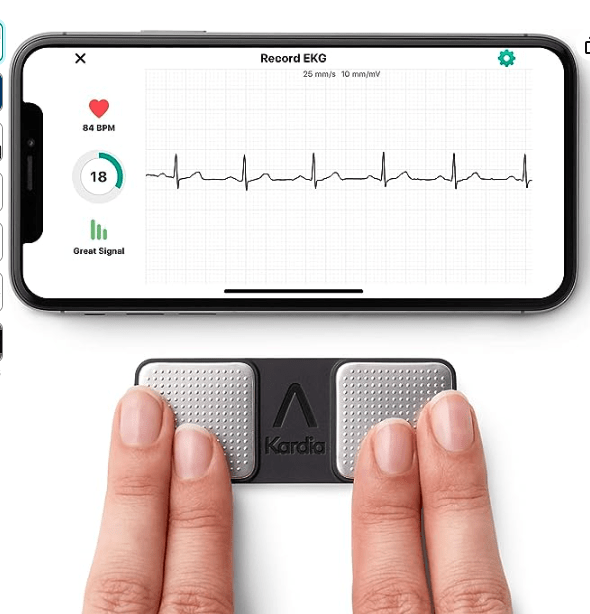
I have taken hundreds of home EKGs since my 2014 incident. For a while I carried my Kardia on bike rides in my jersey pocket, and would take EKGs at the coffee stops.I even did one on a climb up Mont Ventoux, just for grins. All of those EKGs have all been normal. Until October 17….
My nut counting job was at its busiest on October 16, and we expected an even more massive number of trucks the next day. I got home from work late and went to bed early and woke up at 3:30 since I had to get to work by 5:00.
I immediately knew something was wrong, and I knew what it was. Kardia confirmed the diagnosis. My heart rate was 106 and the EKG report was ‘Possible Atrial fibrillation’.
I sent a text to my walnut counting boss, then headed to the ER at Lodi Memorial. I wasn’t nervous at all, since I was pretty sure I knew what was happening. I was sorry and upset to have to let my walnut counting duties slide, but I really didn’t have a choice.
At the ER when they asked me why I was there I told them I was in AFib. They aren’t used to self diagnosis like that. After only a short wait they took me behind a curtain and did an EKG and concluded I was in AFib. They probably charged Medicare $1,000 for it. My $89 Kardia with a free App on my cell phone came to the same conclusion.
Eventually I saw a doctor, a very nice woman who actually listened to my story about this being AFib Incident #2, 9 years removed from Incident #1. Eventually I left the ER with a script for Eliquis and a follow up appointment with my family doctor the next morning.
I went to my nut counting job and arrived at 9 am. The truck drivers wondered what I was doing there. But there really wasn’t any reason to stay home. I did several EKG’s that day and all of them indicated AFib and an elevated pulse.
The next morning I woke up and knew that, unlike 2014, the AFib was still with me. Kardia agreed, although my heart rate was ‘only’ 90 bpm. I went to work at 6 am, but left to go to my doctor’s appointment around 9.
As I was driving to Lodi, I noticed that the strange tingling sensation in my chest and the light headedness seemed to be fading. By the time I got to the medical office, I felt normal. Kardia agreed: I took an EKG right there in the parking lot and it said 60 bpm and Normal Sinus Rhythm. Hooray! It felt like a frisson leaving my body followed by calmness and relaxation.
I’ve done a lot of EKGs over the last 5 weeks, and they’ve all been normal. I’m still on Eliquis, at least for now. More sticker shock: I have a Part D insurance plan but I opted for a low premium with a high deductible, so the first month tab was $500. More than our PGE bill! Although month #2 was only $150.
If I go another 9 years without going into AFib, do I need to stay on Eliquis? Should I risk cycling and possibly crashing while on it? Would I rather risk bleeding to death or having a stroke? The safest advice would be to stay on Eliquis and stop cycling on the road. Difficult choices…
 Rich Freggiaro Cycling Blog
A bit of a dilemma there Rich. We accept certain risks when we choose to cycle-crashes, traffic, mechanical failures. Yours is different from the usual list but no less undesirable consequences. I choose to ride and I’m suffering a fractured rib right now caused by a downhill bump that tossed the bike and I couldn’t regain control. I do plan to continue riding once I’m fully healthy and recovery is complete
These are choices we make with our eyes open and our fingers crossed, additionally most of us use technology and experience to pad our risk level, like heart rate monitors or e-bikes. Anything to reduce the risk of injury is added to our kit/gear
Whatever you choose I hope you enjoy a long and enjoyable ride, happiness is a choice
LikeLike