Last week, the Washington Post spoke with several economists who listed their ideas on how to solve the economic issues facing the nation. One idea listed for the White House to “combat inflation” was price controls. The idea was suggested by the Roosevelt Institute’s Todd Tucker, in which he argued that the time may be at hand to “destigmatize” concerns over price controls.
“To ensure that the wealthy do not bid up prices for essential items, the time is now to begin destigmatizing greater democratic control over price levels,” Tucker concluded.
You might think economists know a lot. They have complicated mathematical models and theories (Pareto Optimality, anyone?) and can be seen making predictions and proclamations on television with great confidence. They speak in a kind of code. Terms like ‘money supply’, ‘quantitative easing’, ‘deficit spending’, ‘currency fluctuation’, ‘excess demand’ and ‘the federal funds rate’ come tripping off of their tongues.
Of course the track record of these economists in predicting what is going to ensue is not so great. They can always blame this on ‘exogenous shocks’ which means that some variable that the economic model does not take into account changes suddenly and dramatically and disrupts the equations. Covid is a perfect example. But since life itself is kind of a series of exogenous shocks, the usefulness of economists is mostly a moot point.
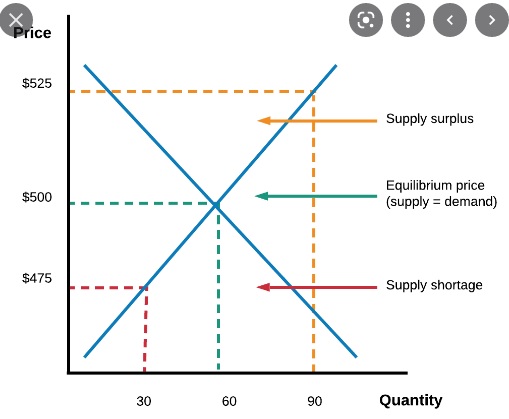
Really, economists do not know so much. But one thing they do know is how to create a shortage. And that is for the government to set the price of a commodity or service below the ‘market price’.
What is this ‘market price? you may ask. I could get all wonky on you and speak of demand curves and supply curves and functions and marginal cost of production equaling marginal price. But since a picture is worth a thousand words, take a peak at this diagram and you’ll get the idea:
Let’s take a real world example using one of Stoker’s and my favorite commodities: Côtes du Rhône vin rouge. The typical bottle that finds its way to our Raley’s market sells for about $12. At that price Stoker and I will purchase a bottle a day, to keep the Covid away. Remember my last blog? Got to keep stocked up.
Now $12 is the free market price, balancing production and consumption. Stoker and I would pay much more, but because there are consumers who will switch to something else at a higher price, we don’t have to. Similarly, there are producers who are willing to produce the wine for less than $12, but they don’t have to accept less. The market price balances the value of the product to the last consumer with the production cost of the last producer. In Econ speak, the market clears when Price = Marginal Cost of Production = Marginal Value to Consumer.
Now let’s say that the government determines that this $12 price represents a case of the ‘wealthy‘ bidding up the price of an ‘essential item‘ and so decides to exercise ‘greater democratic control over price levels‘. They decree that henceforth the price of a bottle of Côtes du Rhône vin rouge will be a more Equitable $5. Selling it for more is now a crime.
This well intended action will have consequences. Demand will increase, because now some people who don’t want a bottle at $12 will be quite happy to pay $5 for it. And supply will fall, because only the most efficient producers will be able to make a profit at $5 per bottle.
The result of this market disruption is that the economy moves from a point of Pareto Optimality to a non Pareto Optimal point. Consumer Surplus and Producer Surplus are both reduced, and everyone is less well off (aka ‘poorer’) than they would be had the government not gotten into the price setting business. Oops, I did get a bit wonky there. Guilty as charged.
If you think gas lines, bread lines, lines at the meat counter or in the Côtes du Rhône vin rouge store are a good idea, just write your congressperson and tell them you think high prices are unfair, inequitable, and perhaps even racist. And that the government needs to set the prices at a reasonable level. Life is only fair when everyone can afford everything and we are all economically equal. Equally poor…
 Rich Freggiaro Cycling Blog
I love your blog Cousin!!!
LikeLike